
Where communication gets stuck
“I understand the subject, but my answer becomes scattered when I have to explain it.”
You may know more than your response suggests. We help you organise your thinking, identify the central message and communicate it in a way your audience can follow.
“I know what I want to say, but I don’t always sound as confident as I feel.”
Professional impact is influenced by structure, tone, delivery and audience awareness - not simply vocabulary or grammar.
“My team has good ideas, but meetings, presentations and written communication are not producing the impact they should.”
We design practical workshops around the real communication situations your people encounter, rather than delivering a generic course.
This is where the 3C Model begins
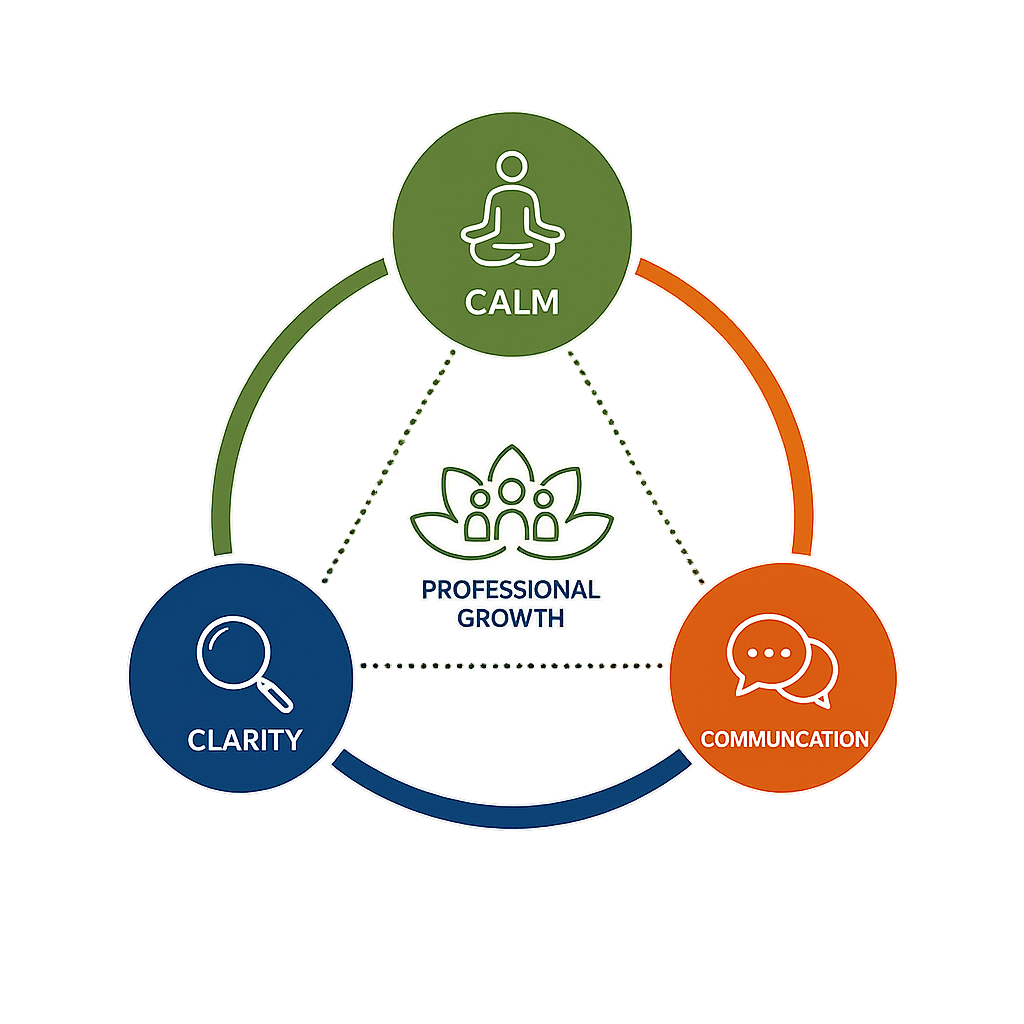
Why we developed the 3C Model
Through years of business leadership, education, social work and working with people, we kept seeing the same pattern: when pressure rises or a situation becomes complicated, even capable people can struggle to identify what really matters and communicate it effectively.
Pressure made answers feel rushed. Too much information buried the central message. Strong ideas lost their impact because they were not shaped for the audience.
The 3C Model grew from that experience.
The 3C Model is a practical way of approaching situations where people, decisions and communication intersect. It starts by creating enough Calm to think, finding the Clarity to identify what really matters, and using Communication to move the situation forward.
Effective communication is not simply about finding better words. It begins with creating the calm to think clearly, identifying the message that matters and adapting it to the audience in front of you.
How the model works
-

Create space to think
Pressure can make us speak too quickly, over-explain or lose track of what we want to say.
Calm does not mean removing every sign of nervousness. It means developing enough control to listen, think and respond deliberately - even when the conversation matters.
We help you manage the moment so your knowledge and experience have a better chance of coming through.
-

Decide what matters
We help you separate the central message from the supporting detail, organise your ideas logically and make your purpose clear to the listener.
The goal is not merely to say more. It is to make the important parts easier to understand and remember.
Sometimes that means clarifying a message. Sometimes it means clarifying the problem itself. -

Shape the message
A clear idea only has value when it reaches the person in front of you.
We help you adapt your language, tone, evidence and delivery to the audience, purpose and professional context.
That may mean explaining a complex idea simply, giving difficult feedback, making a recommendation persuasively, getting a team behind a decision or adapting your approach across cultures.
-

Put it into practice
The value of the model comes from using it in real situations.
With practice, the process becomes more natural: creating space before reacting, identifying what really matters and communicating with greater purpose.
Each situation also gives you something to learn from. What worked? What didn’t? What would you do differently next time? That reflection turns a useful framework into an increasingly instinctive way of working.
What the 3C Model looks like in practice
-
In a difficult conversation
Instead of reacting immediately or avoiding the issue, you create enough space to understand what needs to be said, identify the outcome you need and approach the conversation deliberately.
-
In an MBA case discussion
You move from extensive analysis to a focused recommendation — explaining what matters, why it matters and how you reached your conclusion.
-
In a business problem
You step back from the immediate symptoms, work out what is really getting in the way and identify the next practical step.
-
Across a team
The model gives people a shared way of approaching meetings, feedback, decisions and communication — creating greater clarity around what needs to happen next.
Working with real situations

The 3C Model is most useful when it is applied to something that actually matters.
That might be a presentation you need to deliver, a difficult conversation with a staff member, an MBA case, a team communication problem or an issue in your business that you have been trying to untangle.
We use the model to slow the situation down, identify what really matters and work towards a practical response.
Where training or practice is useful, we can also use role-play, case discussions, recorded responses and customised scenarios to test different approaches before you use them in the real world.
Calm enough to think. Clear enough to know what matters. Communication that moves things forward.
LET’S GET STARTED
Tell us what’s getting stuck
You might be dealing with a communication problem, a difficult workplace situation, an MBA case, a team challenge or something in your business that simply isn’t working as well as it should.
Start with a free 20-minute conversation.
Tell us what is happening and we’ll work out whether we can help and where it makes sense to begin.
No standard package. No obligation.
Just a useful first conversation.